
Helping you find the translation that fits your faith journey
Why Choosing a Bible Matters
The Bible is God’s Word — living, active, and powerful. But with so many translations available, it can feel overwhelming to choose which one. This guide will help you understand the differences so you can select a Bible that you’ll read, understand, and grow with.
Understand the Three Types of Translations
Word for Word (Formal Equivalence)
These translations stay as close as possible to the original Hebrew and Greek wording.
Best for:
Deep study, Sermon prep, Readers who prefer accuracy over simplicity
Examples:
KJV, NKJV, ESV, NASB
Thought for Thought (Dynamic Equivalence)
These translations aim to convey the text’s meaning in clear, modern language.
Best for:
Daily reading, New believers, Devotional use
Examples:
NIV, CSB, NLT
Paraphrase
These are not direct translations but retellings of Scripture in very contemporary language.
Best for:
Big picture understanding, Reading alongside a more literal translation, Fresh perspective
Examples:
The Message (MSG). The Living Bible (TLB)
Consider Your Purpose
Use this quick guide to match your needs with the right translation:
For deep Bible study
Choose: ESV, NASB, NKJV. Why: These stay closest to the original languages.
For everyday reading
Choose: CSB, NIV. Why: They balance accuracy with readability.
For devotionals or new believers
Choose: NLT Why: It’s warm, clear, and easy to understand.
For a fresh perspective
Choose: MSG Why: It helps you hear familiar passages in a new way.
Think About Readability
Different translations have different reading levels:
KJV — 12th grade
NASB — 11th grade
ESV — 8th grade
NIV/CSB — 7th grade
NLT — 6th grade
MSG/TLB — 4th–5th grade
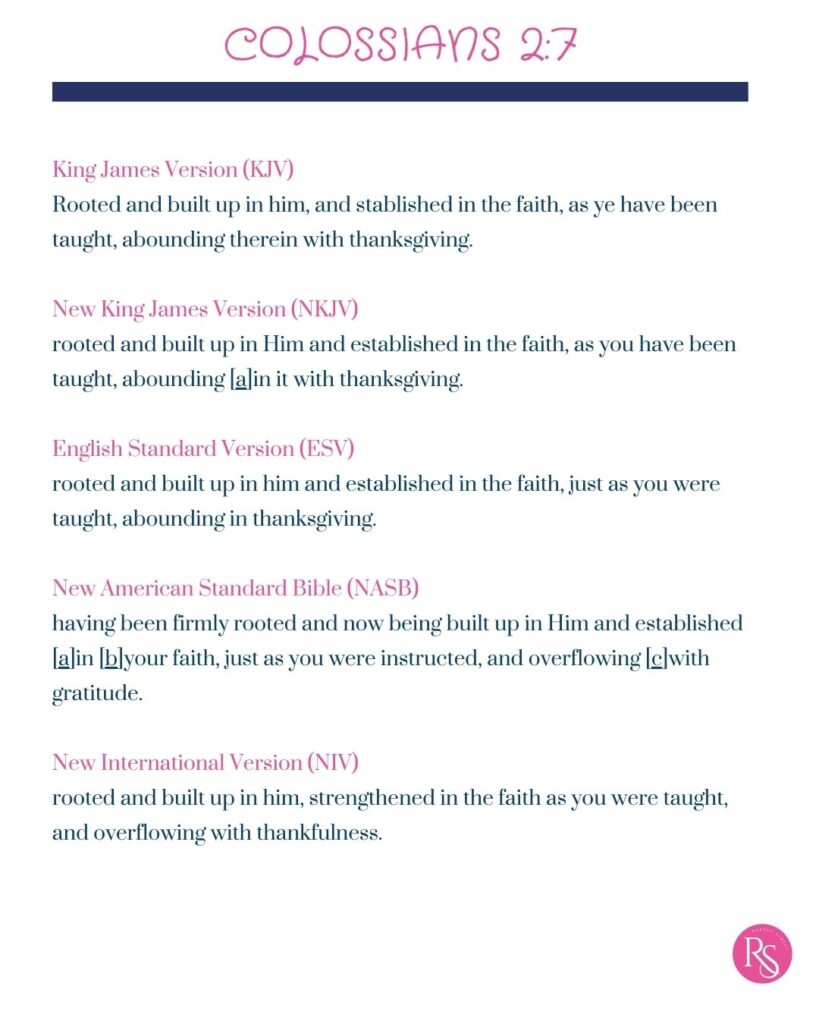
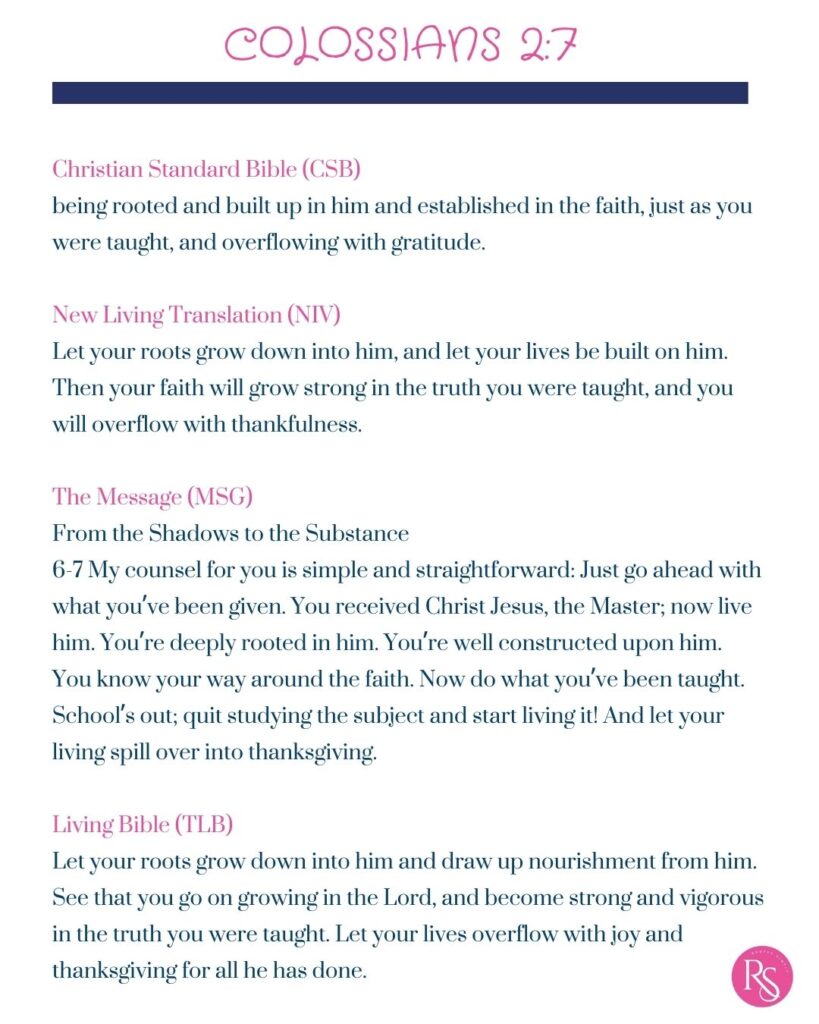
Choose a translation that feels natural and comfortable for you. Click the download to see Colossians 2:7 in all the various formats.
Decide on Format & Features
Consider what will help you engage with Scripture:
Study Bible (notes, maps, charts)
Journaling Bible (wide margins)
Large print Bible
Compact Bible
Red letter edition
Reference Bible (cross references)
Think about where and how you’ll use your Bible — at home, in church, on the go, or for study.
Try Before You Buy
Most Bible apps let you preview translations. https://www.biblegateway.com is a user-friendly site that makes looking up passages and switching translations easy. I have written out each of the translations discussed above for Colossians 2:7. Read the passage in all its versions and notice:
Which one feels clearest?
Which one helps you understand the passage?
Which one draws your heart toward God?
The best Bible is the one you will read consistently.
Final Encouragement
Choosing a Bible isn’t about finding the “perfect” translation — it’s about finding the one that helps you grow closer to God. Whether you prefer a literal translation for study or a readable one for daily devotion, God will meet you in His Word.
I hope this guide helps you choose a Bible that fits your season, your needs, and your walk with Christ.