
Every person interprets reality through a particular lens—a worldview. Whether consciously articulated or quietly assumed, a worldview shapes how individuals answer life’s most foundational questions: Where did we come from? What is wrong with the world? What is the solution? What is the purpose of life? What happens after death? These questions form the architecture of human thought, identity, and behavior.
In a culture saturated with competing belief systems, the Christian worldview stands among many voices calling for allegiance. The apostle Paul reminds believers of the spiritual nature of this competition: “We demolish arguments and every pretension that sets itself up against the knowledge of God…” (2 Corinthians 10:5). This is not a mandate for arrogance or intellectual combativeness. It is a call to clarity, discernment, and spiritual vigilance—not against people, but against ideas that distort truth.
This post explores the major worldviews shaping contemporary culture, contrasts them with the Christian worldview, and offers practical guidance for engaging worldview conversations with grace, wisdom, and confidence.
What Is a Worldview?
A worldview is a framework through which people interpret reality. It answers four foundational questions:
1. Origin — Where did we come from?
Created? Evolved? Emerged?
2. Meaning — Why are we here?
Purpose? Accident? Self-defined?
3. Morality — How should we live?
Objective truth? Personal preference? Cultural norms?
4. Destiny — What happens after death?
Heaven? Nothing? Reincarnation? Unknown?
The Christian worldview offers coherent, beautiful, and historically grounded answers:
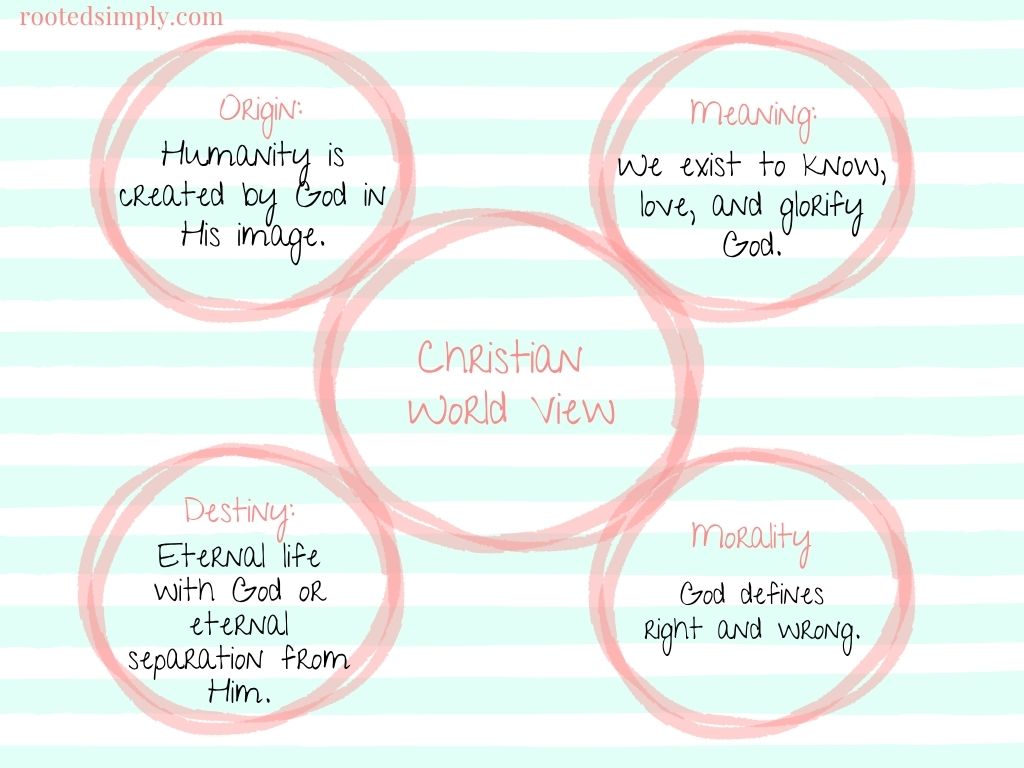
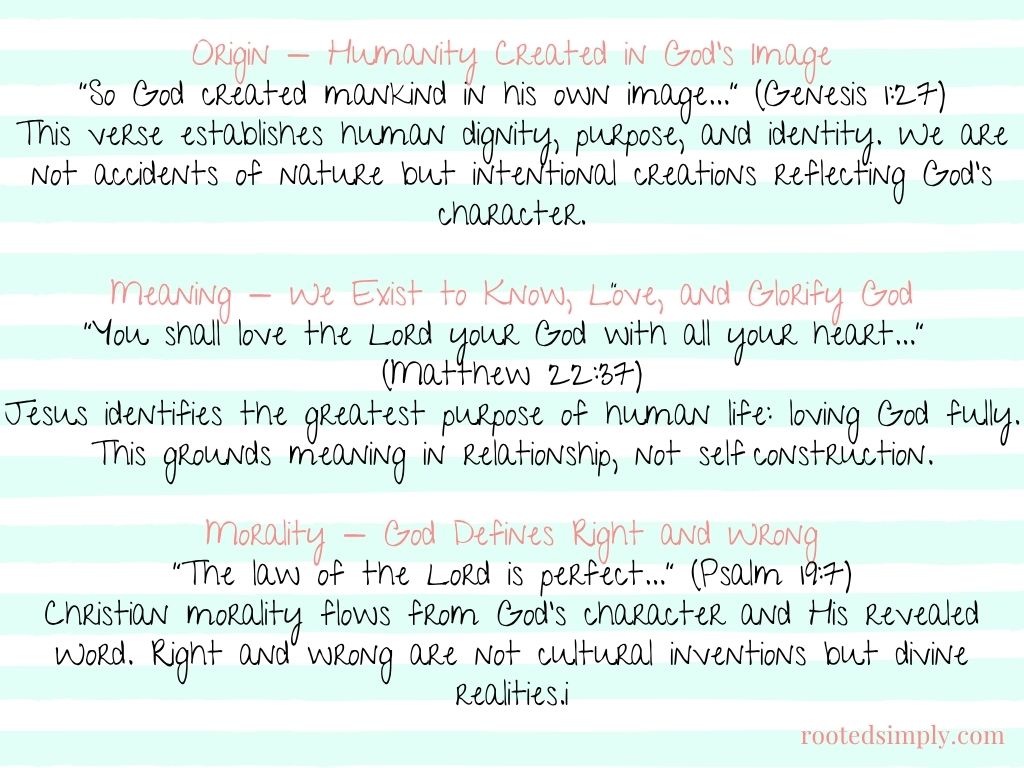
Origin: Humanity is created by God in His image.
Meaning: We exist to know, love, and glorify God.
Morality: God defines right and wrong.
Destiny: Eternal life with God or eternal separation from Him.
Every competing worldview answers these questions differently—and those answers shape culture, ethics, identity, and hope.
Naturalism: The Worldview of Secular Culture
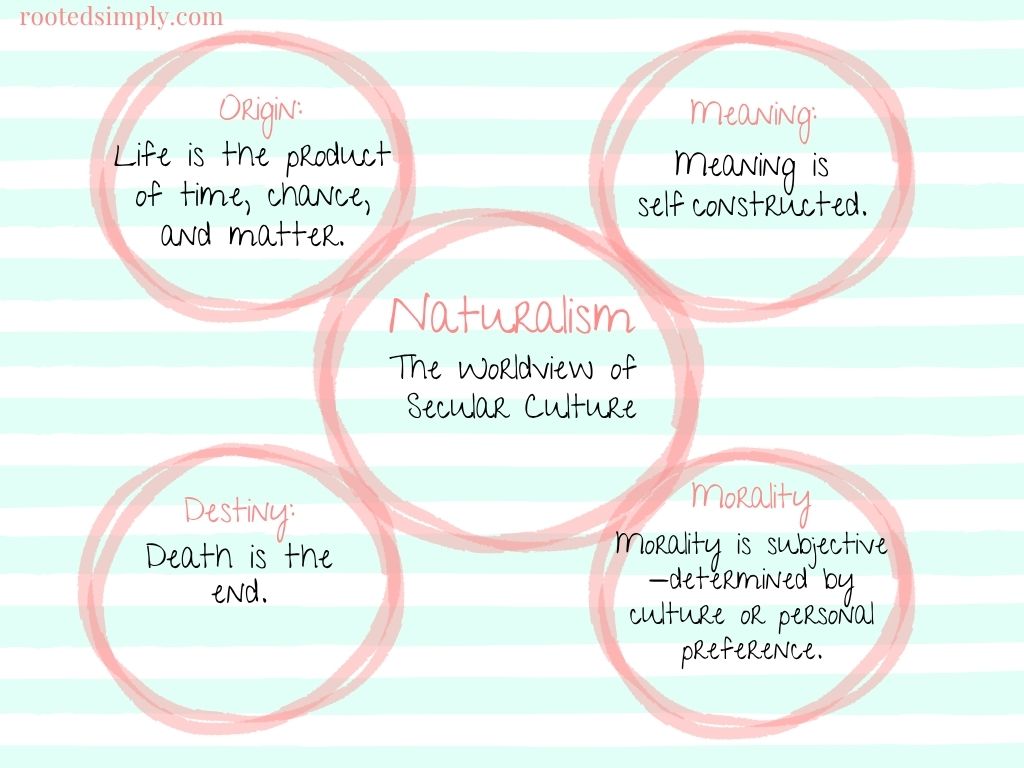
Naturalism presents a worldview in which the physical universe is the entirety of reality, and everything—from galaxies to human thoughts—arises from natural causes alone. Within this framework, morality is subjective, shaped by personal or cultural preference rather than any transcendent standard. Death is the end, closing the story of human existence with no continuation beyond the grave. Naturalism’s appeal lies in its trust in scientific reliability, its avoidance of religious conflict, and its promise of personal autonomy—though that autonomy is ultimately an illusion if humans are nothing more than the accidental products of impersonal forces. Yet the worldview struggles to account for consciousness, objective morality, love, beauty, purpose, and even existence itself. From a Christian perspective, naturalism reduces human beings to biological machines, while Christianity affirms humans as image‑bearers of God, endowed with inherent dignity, meaningful purpose, and eternal significance.
Postmodernism: The Worldview of “Your Truth”
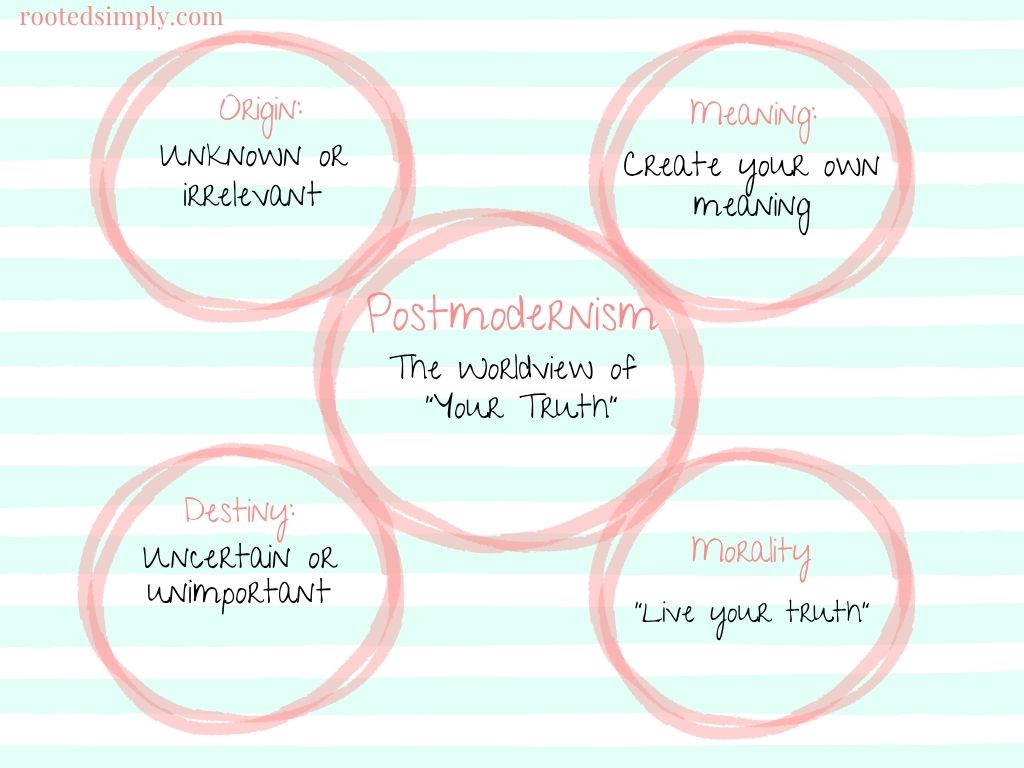
Postmodernism is best understood not as a formal religion but as a cultural mood—one marked by skepticism toward absolute truth and suspicion toward authority. In this perspective, the origin of life is unknown or irrelevant, and meaning becomes something each person must create for themselves. Morality follows the mantra “live your truth,” emphasizing personal authenticity over universal standards. Destiny is viewed as uncertain or unimportant, reflecting postmodernism’s general reluctance to make definitive claims about the future. This mindset has strengths, including its emphasis on empathy, its willingness to challenge oppressive systems, and its honest acknowledgment of human limitations. Yet it also carries significant weaknesses: it is often self-contradictory, struggles to consistently condemn evil, cannot coherently define identity, and ultimately fails to offer lasting hope. In contrast, Christianity affirms the existence of objective truth while also upholding compassion, humility, and justice—qualities embodied perfectly in Jesus, who unites both grace and truth.
New Age Spirituality: The Worldview of Self-Divinity
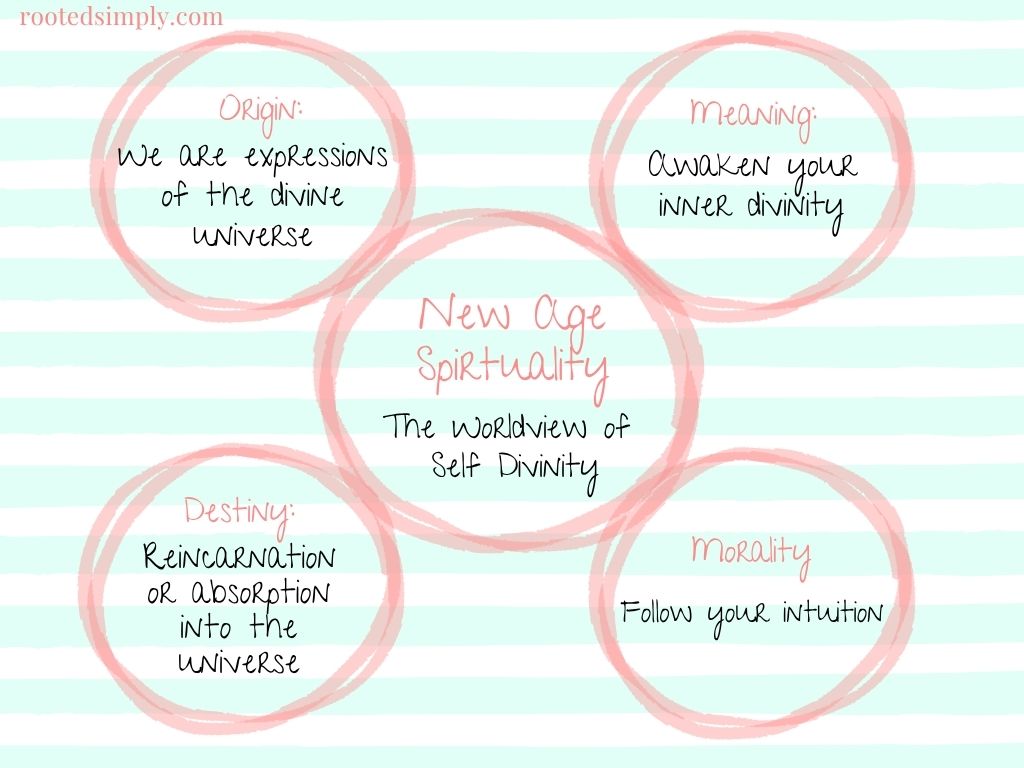
New Age spirituality blends elements of Eastern religion, mysticism, and modern self-help, teaching that God is an impersonal force and that individuals themselves are divine. In this view, our origin lies in being expressions of a universal divine energy, and meaning is found by awakening one’s inner divinity. Morality is guided by intuition rather than objective standards, while destiny is often described in terms of reincarnation or eventual absorption back into the universe. This approach has strengths, including its emphasis on spirituality, peace, mindfulness, and its rejection of cold materialism. Yet it also carries significant weaknesses: it contradicts itself, cannot adequately explain evil or justice, and cannot account for the historical and theological uniqueness of Jesus. Christianity responds by affirming that God is personal, not an impersonal energy; that humans are creatures, not gods; that salvation comes through grace, not self-realization; and that Jesus is the only way to God.
Islam: A Works-Based Monotheism
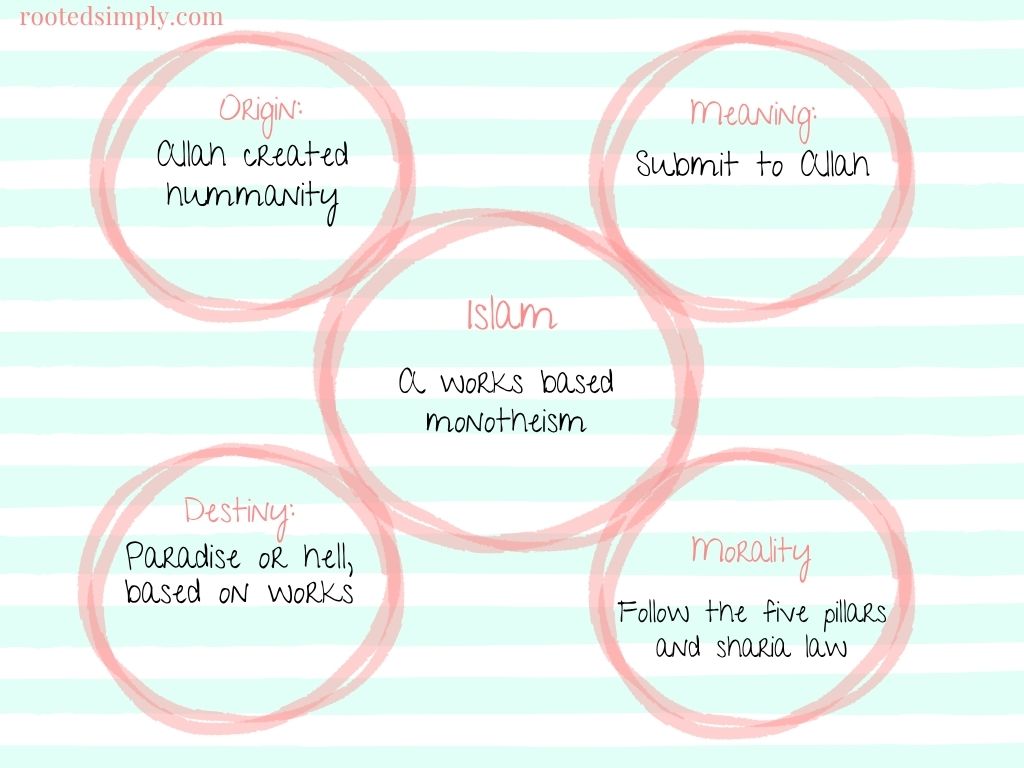
Islam affirms the existence of one God and holds Jesus in high regard as a prophet, yet it denies His deity, His sacrificial death, and His resurrection. In Islamic belief, origin is rooted in Allah’s act of creating humanity, and meaning is found in submitting fully to His will. Morality is shaped by obedience to the Five Pillars and adherence to Sharia law, while destiny is understood as either paradise or hell, determined by one’s works and faithfulness. Islam’s strengths include a strong moral framework, a clear sense of community identity, and deep reverence for God. However, it also has weaknesses: it rejects the cross and resurrection, offers no assurance of salvation, and struggles to reconcile divine justice with divine mercy. Christianity responds by offering a relational God, a Savior rather than a prophet, grace instead of works, and the assurance of salvation rather than uncertainty.
Atheism: The Worldview of Denial
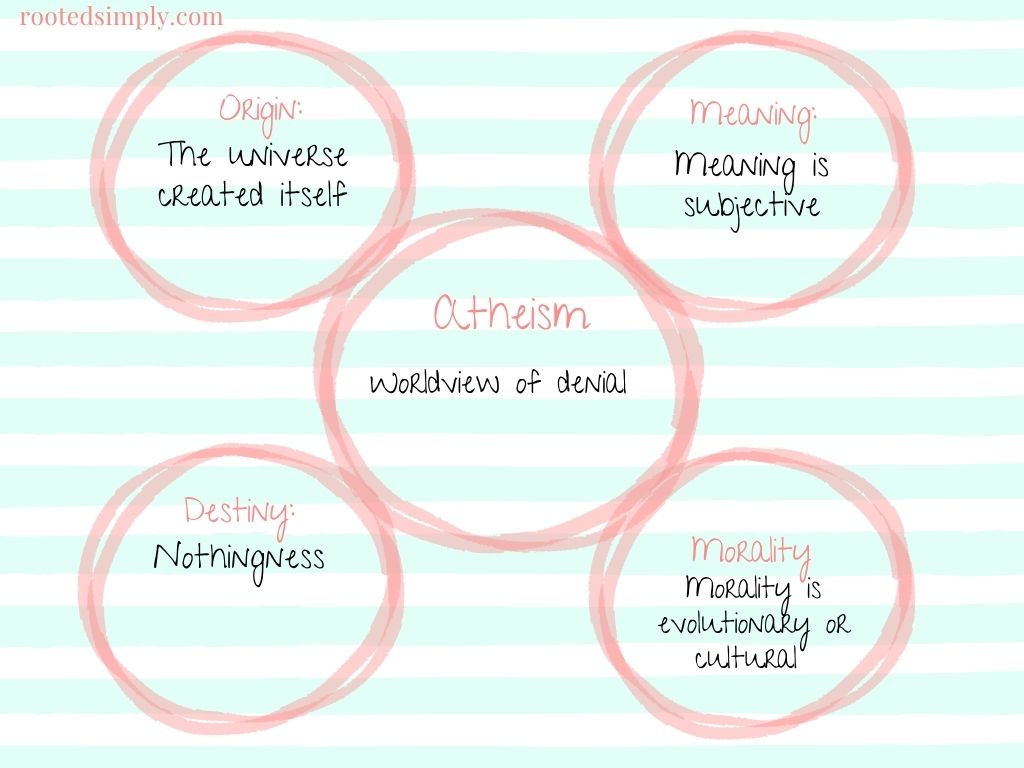
Atheism asserts that God does not exist and views religion as a human invention rather than a revelation from the divine. In this worldview, origin is explained by the idea that the universe created itself through natural processes, and meaning becomes entirely subjective, shaped by personal preference or cultural influence. Morality is understood as an evolutionary development or a social construct, not something grounded in any transcendent source. Destiny is ultimately nothingness, as atheism denies any form of life beyond death. This perspective has strengths, including its appeal to reason, its rejection of hypocrisy, and its emphasis on evidence. Yet it also has significant weaknesses: it cannot adequately explain the existence of the universe, the foundation of morality, the nature of consciousness, or any hope beyond death. Christianity responds by affirming both reason and evidence, while also offering objective meaning, a coherent moral foundation, and genuine hope rooted in the person and work of Jesus Christ.
Agnosticism: The Worldview of Uncertainty
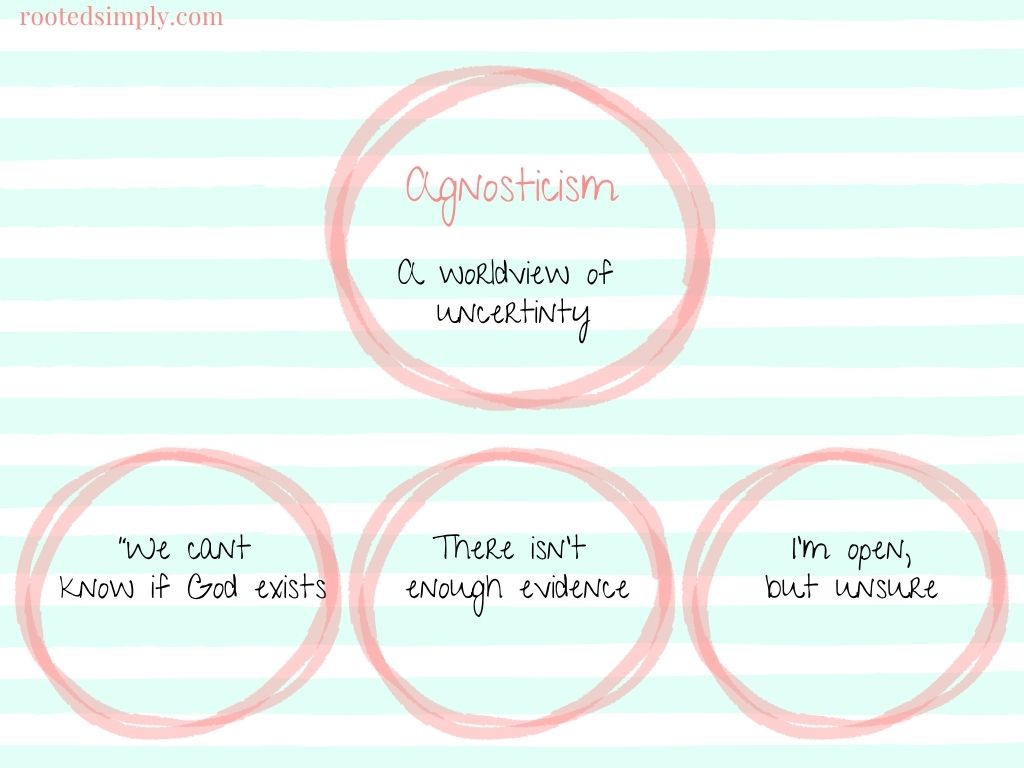
Agnosticism maintains that human beings cannot know for certain whether God exists, positioning itself as a worldview of unresolved questions and suspended judgment. It has strengths, such as its honesty about doubt, its openness to conversation, and its avoidance of rigid dogmatism. Yet it also has notable weaknesses: it often avoids meaningful commitment, overlooks the evidence that is available, and ultimately cannot answer life’s biggest and most pressing questions. In contrast, Christianity welcomes honest seekers and invites those who doubt to thoughtfully examine the evidence; Jesus Himself encourages sincere inquiry rather than blind belief.
Why the Christian Worldview Is Unique
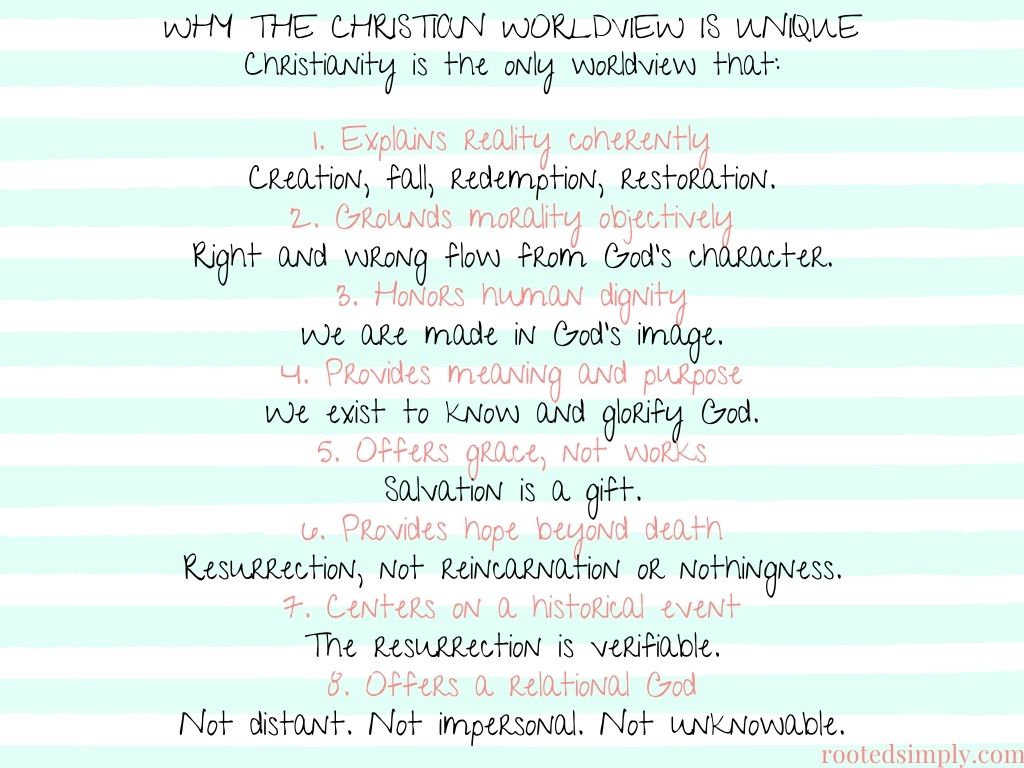
The Christian worldview is unique because it is not simply one option among many competing belief systems; it stands apart as the only worldview that explains reality coherently, grounds morality objectively, honors human dignity, and provides deep meaning and purpose. Unlike systems that rely on human effort, Christianity offers grace rather than works and provides hope beyond death, rooted in the historical resurrection of Jesus Christ. It presents a relational God who knows, loves, and pursues humanity. In every dimension—intellectual, emotional, and spiritual—Christianity offers a framework that is satisfying, healing, and transforming.
How to Have Worldview Conversations with Grace
Apologetics is not about winning arguments—it is about winning people.
1. Ask Good Questions
Questions open hearts. Try asking about beliefs, morality, suffering, or destiny.
2. Listen Without Interrupting
People feel valued when they feel heard.
3. Look for Common Ground
Affirm shared values like justice, compassion, reason, and spirituality.
4. Gently Expose Inconsistencies
Ask thoughtful questions that help others see gaps in their worldview.
5. Share the Christian Story
Present Christianity as a better story—not merely a better argument.
6. Share Your Testimony
Your personal story carries unique power.
7. Keep the Focus on Jesus
He is the center of the Christian worldview.
8. Be Patient
Worldview shifts take time.
9. Pray
Only the Holy Spirit opens hearts.
A Simple Framework for Worldview Conversations
A simple and effective way to navigate worldview conversations is to use a four step framework that keeps the dialogue clear, relational, and respectful. First, Clarify by asking what the other person believes, allowing them to express their perspective in their own words. Second, Compare by exploring how their worldview addresses life’s biggest questions—origin, meaning, morality, and destiny. Third, Contrast by gently showing how Christianity answers those same questions differently, offering coherence, hope, and grace. Finally, Commend by sharing why you personally believe Christianity is true, pointing to its historical foundation, intellectual strength, and transformative power. This approach avoids argument, builds trust, and opens the door for meaningful, fruitful conversations about faith.

Truth Is Not a Weapon—It Is a Gift
We live in a world full of competing worldviews—some attractive, some confusing, some destructive. All are incomplete. Only the Christian worldview explains reality, satisfies the mind, heals the heart, transforms the soul, offers grace, provides hope, and leads to Jesus.
The Christian calling is not to win debates but to shine light—to speak truth with love, to engage culture with wisdom, and to point people to the One who is the Way, the Truth, and the Life.
1 thought on “Week 11 Everyone Has a Worldview – But Not Everyone Knows It Part 1”