

The Most Important Question You Will Ever Ask

Few questions are more foundational or more debated than whether God exists. For Christians, believing in God is not just a philosophical choice; it is at the heart of our worldview, shapes our identity, and gives us hope. Still, in a world influenced by skepticism, secularism, and different truth claims, many believers quietly wonder how we can know God is real. Many skeptics also ask this question sincerely.
This week, we will look at classical and biblical arguments for God’s existence. These are not just academic ideas—they are tools to strengthen your faith, deepen your worship, and help you engage with a skeptical world with confidence, humility, and compassion.
Every worldview—religious or secular—must answer the question: Does God exist?
This is not a minor question. It is the question that lies beneath all others. If God exists, then life has meaning, purpose, accountability, and direction. If God does not exist, then meaning is invented, morality is subjective, and hope is fragile. God’s existence is not only a philosophical idea. It is the foundation of reality itself. And Scripture boldly declares that God has not hidden Himself.


Why The Question Of God’s Existence Matters
Before we look at the classic arguments for God’s existence, it helps to see why this question matters so much. What you believe about God shapes how you view everything else. If God exists, then truth is objective, morality has a solid foundation, human dignity is built in, purpose is given, and eternity has meaning. If God does not exist, then truth is just personal preference, morality is only opinion, human value is uncertain, purpose is something we make up, and death is the end. So, what you believe about God becomes the lens through which you see reality. That’s why conversations about God’s existence are not just abstract ideas—they are closely tied to how we live, think, and hope.
The Bible starts by assuming God’s existence, not by arguing for it, but by stating, “In the beginning, God…” Still, the Bible also says that God has shown evidence of Himself through creation, our conscience, and our ability to reason. Psalm 19 says the heavens declare God’s glory, and Romans 1:18–20 explains that God’s qualities are clearly seen in what He has made. Rather than asking for blind faith, Scripture encourages us to notice the signs of God in the world around us. This foundation is why the cosmological, design, and moral arguments are so convincing—they fit with what the Bible already tells us.
Apologetics is important for both believers and skeptics. For believers, it builds confidence by showing that faith has a strong intellectual and historical basis. For skeptics, apologetics can help remove doubts that might keep them from exploring the gospel. For everyone, it encourages deeper conversations about truth, meaning, and who God is. The goal of apologetics is not to win arguments, but to clear up confusion so people can meet the God who is already reaching out to them.
Apologetics For Discipleship

Apologetics helps discipleship by deepening worship. When believers see the universe as the intentional creation of a powerful and personal God, their worship is filled with awe. Understanding morality as an expression of God’s character, not just a human idea, turns obedience into something joyful. When people realize that personal experiences of God, like answered prayer, conviction, comfort, or transformation, are real encounters with the living God, their faith becomes more vibrant. Apologetics connects the mind and heart, allowing worship to come from truth, wonder, and gratitude.
Apologetics also helps believers feel more confident. Many Christians worry about difficult questions, thinking their faith might be weak. But when they learn about strong arguments for God’s existence, like the cosmological, design, and moral arguments, their doubts lose strength. Their faith is based not just on feelings, but on solid reasons. They see that Christianity makes sense intellectually, has a strong history, and is logically sound. This confidence does not make them proud, but steady. They do not feel the need to hide their faith or avoid tough conversations. Instead, they can talk about their beliefs with humility and clarity, knowing their trust in God is well supported.
Apologetics prepares believers to help others grow. As disciples learn more, they can guide their children, small groups, and church communities. They become people who say, “Let’s explore this together,” instead of avoiding questions or giving quick answers. Apologetics helps disciples become mentors who walk with others patiently and wisely. It gives them the tools to help others face doubts, ask hard questions, and find the beauty and truth in the Christian faith. In this way, apologetics is not just about learning, but about caring for others.
The Cosmological Argument: Why Is There Something Rather Than Nothing?

The cosmological argument is one of the oldest and strongest reasons for believing in God because it starts with a question every worldview must answer: Why does anything exist at all? At its core, this argument says that everything that begins to exist has a cause, and since the universe began to exist, it must have a cause too. That cause cannot be part of the universe, since the universe did not always exist. Instead, it must be timeless, spaceless, immaterial, unimaginably powerful, and personal. These are qualities that match the God described in Scripture. The cosmological argument is not just abstract philosophy; it simply follows the logic of cause and effect to its most reasonable conclusion.
Modern science supports this reasoning. The Big Bang theory, which some see as a challenge to faith, actually supports the biblical idea that the universe had a beginning. If the universe is not eternal, it cannot exist on its own. Something outside the universe must have brought it into being. And “nothing” is not a real explanation, since nothing cannot create, cause, explode, or produce order. If something exists now, then something—or more accurately, Someone—must have always existed. The fact that the universe is finite points to an eternal, necessary being who does not depend on anything else for His existence.
Scripture makes this clear: “In the beginning, God created the heavens and the earth.” God is not created; He is the uncaused cause and the eternal foundation that everything else depends on. This matters because it shows that belief in God is not just blind faith or wishful thinking. It is a rational conclusion based on the existence of the universe. The cosmological argument reminds us that Christianity does not ask us to ignore reason. Instead, it invites us to follow reason back to the One who created everything.
The Design Argument: Order Requires A Designer


The design argument, also called the teleological argument, starts with a simple observation: the universe is not just orderly, but finely tuned for life. It is not roughly or accidentally tuned, but precisely tuned. The laws of physics work with amazing precision. For example, if the gravitational constant changed by even 1 part in 10⁶⁰, life would not be possible. If the strong nuclear force were a bit stronger or weaker, atoms could not form. If the universe expanded at a slightly different rate, galaxies would not have formed. These details are not signs of randomness or chaos; they show intentional design. The design argument points out that this kind of precision suggests an intelligent Mind behind the universe.
We see this same intentionality in biology. DNA, the molecule of life, is more than just a chemical structure; it is like a language. It has billions of letters arranged in meaningful, information-rich sequences. Information always comes from intelligence. We have never seen a poem write itself, a code appear on its own, or a blueprint form by accident. Yet DNA is much more complex than any human language or computer program. Its existence points to a Designer who is both brilliant and purposeful. Scripture supports this idea, saying, “The heavens declare the glory of God” (Psalm 19:1) and “By Him all things were created” (Colossians 1:16). Creation is not silent; it clearly shows the work of its Creator.
This matters because it shows the universe is not a random accident or the result of blind forces. The design argument reveals a world filled with purpose, beauty, and intentionality, which reflect the character of a wise Creator. Belief in God is not a leap in the dark; it is a reasonable conclusion based on the order, complexity, and elegance we see in the world.
The Moral Argument: Where Does Right And Wrong Come From?


Every human culture throughout history, no matter where or what they believe, holds to moral values. We might disagree on the details, but we all agree that love is good, murder is wrong, justice is important, and cruelty is evil. The real question is why we believe these things. If morality were just a social invention, it would change a lot or fall apart under pressure. Instead, we find a deep, shared sense that some things are truly right or wrong, not just inconvenient or unpopular. This is where the moral argument begins: our moral experience points beyond ourselves.
If God does not exist, then objective morality cannot exist either. Without a higher source, morality becomes subjective, shaped by culture, preference, or personal feeling. But deep down, we know morality is more than just opinion. We do not just prefer that murder is wrong; we believe it is wrong everywhere, at all times, for everyone. Moral laws need a moral Lawgiver. Just as physical laws point to someone who set order in the universe, moral laws point to a source who defines goodness itself. You cannot get moral obligation from atoms, human dignity from molecules, justice from physics, or purpose from chemistry. Morality always points to something greater than the material world can explain.
Scripture supports this by teaching that God has written His law on our hearts (Romans 2:15) and calls His people to be holy because He is holy (1 Peter 1:16). We know right from wrong because we are made in the image of a moral God. Our conscience is not just an evolutionary accident; it reflects His character. This matters because it shows that our deepest moral instincts are not just products of biology or culture—they are signs of God’s presence. The moral argument reminds us that when we long for justice, goodness, and love, we are responding to the God who is the source of all three.
Personal Experience: The God Who Reveals Himself

Philosophical arguments can point us toward God, but personal experience helps us know Him in a way that is relational, life-changing, and deeply human. Across cultures, languages, and centuries, billions of people have shared stories of meeting God—experiences of forgiveness, change, answered prayer, conviction, comfort, calling, and even miracles. These shared experiences are not just the result of imagination or cultural habits; they are evidence of a God who wants a relationship with us. Personal experience with God does not replace reason, but it strongly confirms what reason already suggests: God is real and close.
Christianity is also based on real historical events, not just private spirituality or myth. The resurrection of Jesus is at the heart of the Christian faith, supported by eyewitness accounts, the empty tomb, hostile witnesses who had nothing to gain, early creeds that spread soon after the event, disciples who were changed and willing to die for what they saw, and the rapid growth of the early church. These historical facts remind us that Christian experience is grounded in reality, not just wishful thinking. When people meet God today—through conviction, comfort, or calling—they are responding to the same risen Christ who left the tomb two thousand years ago.
Finally, Scripture teaches that the Holy Spirit confirms God’s reality in the hearts of believers. Romans 8:16 says, “The Spirit Himself testifies with our spirit that we are God’s children.” Apologetics can open the mind, but the Spirit opens the heart. Personal experience does not replace evidence; it adds to it, bringing together reason, history, and relationship into a living faith. It reminds us that God is not just an idea to study, but a Person who reveals Himself, invites us into His presence, and changes us from the inside out.

Why Some People Reject God Despite The Evidence
Romans 1:18–20 teaches that God’s existence is not hidden. His fingerprints can be seen throughout creation. Yet Paul says people “suppress the truth,” ignoring what is clear. This leads to a real and caring question: Why would anyone reject God if the evidence is so strong? The answer is rarely simple, and it is almost never just about intellect. People resist God for deeply human reasons, including moral, emotional, cultural, and personal factors.
One important reason is moral resistance. If God is real, then so is moral truth. Sin, judgment, and accountability all become real as well. For some people, the challenge is not the evidence for God but what it means if God exists. A holy and personal God has authority over our lives, and that can feel threatening. Rejecting God can be a way to avoid facing guilt, surrender, or change. This is not about intelligence; it is about the heart. The moral argument shows this tension. Our moral instincts point to God, but we often resist the very Lawgiver they suggest.
Some people reject God because of emotional wounds. Many have deep pain from being hurt by the church, suffering, or disappointment. These are not just philosophical objections; they are real wounds that shape how someone sees God. When people are hurt by those who claim to represent God, rejecting God can feel like a way to protect themselves. These barriers call for compassion, not arguments. Often, the real question is not “Does God exist?” but “Can I trust Him?”
Another reason is cultural pressure. In many groups, belief in God is seen as old-fashioned, anti-intellectual, or limiting. People worry about being called naïve, unscientific, or bigoted. The urge to fit in can be strong, especially for young adults. Rejecting God can be a way to avoid ridicule or to go along with the main cultural story. This is why calm, confident conversations about the cosmological or design arguments are important. They show that faith can make sense intellectually.
Some people also reject God because they have the wrong idea about who God is. They might imagine God as angry, distant, demanding, or political. In fact, Christians should reject those ideas too. Apologetics helps remove these misunderstandings so people can meet the God shown in Jesus.
When we understand these reasons, we can respond with empathy instead of defensiveness. It reminds us that behind every objection is a person, and often, a story.
How To Talk To Skeptics Without Being Defensive
Apologetics is not about winning arguments. It is about reaching people with gentleness, clarity, and respect. Conversations with skeptics are much more productive when we start by listening instead of lecturing. Most people do not need a quick defense of Christianity; they need someone who truly wants to understand their story. Asking questions like “What led you to that conclusion?” or “What shaped your view of God?” helps us find the real issue, which is often emotional or relational rather than intellectual. Listening builds trust and shows we care about the person, not just the debate. Once we know where someone is coming from, we can figure out if their objection is intellectual, emotional, moral, or relational. We cannot answer a question someone is not actually asking.
It is important to stay calm. Truth does not panic, shout, or get defensive. Curiosity keeps the conversation open, but defensiveness closes it off. Instead of reacting, we can say things like, “That’s an interesting point, tell me more,” or “What do you think would count as evidence for God?” This approach lowers tension and encourages honest conversation. From there, we can share our own journey with God, not as a lecture but as a testimony. Personal stories about how God has been real in our lives, how we have faced our own questions, or how faith helped us through hard times have a power that arguments alone do not. People can debate ideas, but they cannot argue with your lived experience. Using simple, clear explanations instead of philosophical terms keeps the conversation easy to follow. Admitting when we do not know something builds trust instead of making us look weak.
Most importantly, we should keep the focus on Jesus and the gospel. The goal is not to convince someone of abstract ideas or win a debate, but to introduce them to Jesus Christ. He is the image of the invisible God, the fulfillment of the moral law, and the Word through whom the universe was made. Apologetics helps prepare the way, but the gospel is what truly matters. When someone becomes open to Jesus—His character, His compassion, His resurrection—they often become open to God Himself. In every conversation, our aim is not to win but to love, not to pressure but to invite, and not to defend ourselves but to gently and confidently point toward Christ.

Putting It All Together: A Simple Framework
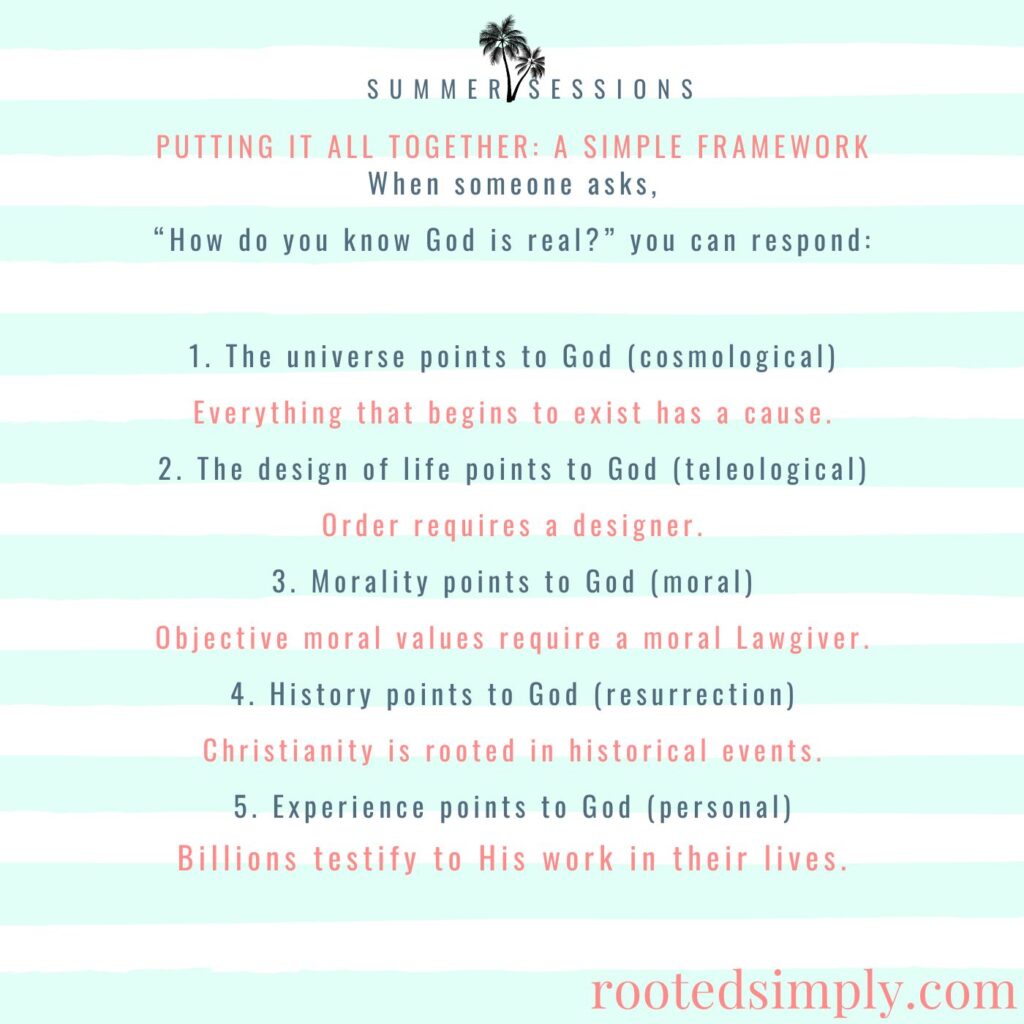
If someone asks, “How do you know God is real?” you don’t have to give a long lecture. Instead, you can share a simple, friendly explanation that brings together the main pieces of evidence. You could start by saying that the universe itself points to God, since everything that begins to exist must have a cause. This is the main idea behind the cosmological argument. Next, you might mention the design and order we see in nature, from the fine-tuning of the universe to the information in DNA, which suggests there is an intelligent Designer. This is what the design argument is about. You can also talk about the moral side of life. Our shared sense of right and wrong, and our belief in real moral values, make the most sense if there is a moral Lawgiver, which is the point of the moral argument. Beyond philosophy, you can point out that history also points to God through the life, death, and resurrection of Jesus. These events are based on eyewitness accounts and historical records, not just myths or guesses. Finally, you can mention that personal experience matters too. Billions of people from different cultures and times have stories of answered prayers, changed lives, and encounters with God that go beyond imagination or chance. When you put all these things together, they give a strong, reasonable, evidence-based trust in God. It’s not blind faith, but a faith built on reality, reason, and relationship.
Reflection Questions for the Week
Which argument for God’s existence resonates most with you—cosmological, design, moral, or
personal experience?
Where have you seen God’s fingerprints in your own life?
How comfortable do you feel talking with skeptics? What makes it challenging?
How might you practice listening more deeply in spiritual conversations?
What step can you take this week to strengthen your confidence in God’s reality?
Practical Application: Talking To Skeptics With Confidence
Build a 2-minute explanation of why you believe in God.
One of the most useful tools in apologetics is having a simple, clear, two-minute explanation of why you believe in God. This is something you can share in a conversation, with a small group, or even with a sincere skeptic. A good way to do this is to include one intellectual reason, one experiential reason, one relational reason, and one gospel reason. Begin with an intellectual point that shows your faith is based on reality. For example, you might say, “I believe in God because the universe had a beginning, and everything that begins to exist has a cause.” This comes from the cosmological argument and shows that your belief is not just blind faith but a reasonable conclusion about the world.
Next, share an experiential reason—something God has done in your life that cannot be explained by natural causes alone. You might talk about how God changed your character, healed you, answered a prayer, or gave you peace when nothing else could. These moments are powerful because they show that God is not just an idea but Someone who acts. After that, add a relational reason that reflects your ongoing relationship with God. For example, you could say, “I’ve seen God guide me, speak through Scripture, and answer prayers in ways that are too specific to be coincidence.” This shows your faith is not only based on past experiences but also on a current relationship with God.
Finally, connect your explanation to the gospel by pointing to the historical reality of Jesus. You might say, “I believe in God because the resurrection of Jesus is historically compelling, supported by eyewitness testimony, an empty tomb, and the transformation of His followers.” This links your personal story to the main claim of Christianity and invites others to think about Jesus for themselves. When you bring together these four elements—intellectual, experiential, relational, and gospel—you create a personal apologetic that is clear, real, and convincing. You do not need to be a philosopher; you just need to honestly share why you trust God.
A Final Word: God Is Not Hiding
The God who made the universe is not silent or far away. He shows Himself through creation, our conscience, the Bible, history, the Holy Spirit, and most of all, through Jesus Christ. Every sunrise, every sense of right and wrong, every page of Scripture, every reminder of the resurrection, and every gentle nudge from the Spirit shows us that God is not hiding. He is inviting us. Apologetics helps us notice what God has already made clear. This week is not about winning arguments or becoming a philosopher. It is about building your confidence, deepening your worship, and learning to share your faith with clarity and kindness. God is real, He is close, and He wants to be known. He invites you to love Him with all your heart, soul, mind, and strength, and to help others see the One who has always been reaching out.